





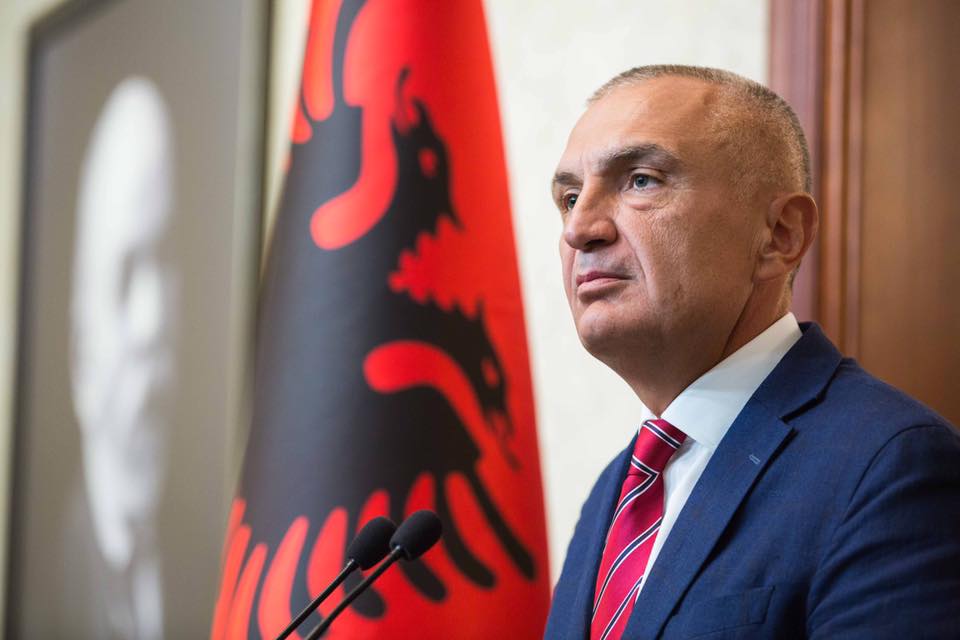
22 Oct Statement by President Ilir Meta on the Decision to Adjourn His Trial and Suspend the Time Limits Governing His Pre-Trial Detention
Justice Under Direction Reaches New Heights.
Today’s hearing in the case against me was delayed by approximately 40 minutes because none of the prosecutors was present at 10:00 a.m., the time scheduled the previous week with the agreement of two of the three prosecutors assigned to the case.
Eventually, however, the door opened and a gentleman in a black robe appeared with great solemnity.
I assumed he must be one of the lawyers appointed by the court, from the list provided by the Ministry of Justice (the Rama IV Government), to defend me.
But my disappointment came quickly. Instead of coming to sit beside me in the glass enclosure, he took a seat opposite me, in the place reserved for the three absent prosecutors.
No sooner had he sat down than the door opened again and the panel of judges entered the courtroom, taking their places on the bench.
The prosecutor, who has absolutely no connection with my case, introduced himself and explained that he had come solely to read out the request submitted by his three colleagues to adjourn the hearing and suspend the running of the time limits governing my pre-trial detention.
Wishing all three prosecutors assigned to my case good health, particularly given the current season of viral infections, I once again asked the panel of judges, as I had also done in an official written submission the previous day, to proceed with my trial. I was, and remain, fully capable of defending myself. Both domestic law and the European Convention on Human Rights guarantee me that right.
The panel of judges withdrew to deliberate. After consulting among themselves, they announced, in a few words, that the hearing would be adjourned not only because my legal counsel, Attorney Bujar Musta, was absent from the lawyers’ bench, although he was present in the courtroom. He is unable to participate because of the conflict between the First Instance Special Court against Corruption and Organised Crime (GJKKO) and the National Chamber of Advocacy, under which his licence is automatically revoked.
The court also blamed the two lawyers it had itself appointed, without even consulting me, from the list provided by the Ministry of Justice (the Rama IV Government), for failing to appear.
Predictably, the court granted the request of the prosecutor who had been sent in as a substitute. He could hardly return empty-handed to his three colleagues, who apparently had more important things to attend to. The request concerned the suspension of the time limits governing my pre-trial detention.
At least, however, the court informed us of one piece of good news: under the European Convention on Human Rights, which takes precedence over domestic legislation, I would be allowed to defend myself at the next hearing, without a lawyer.
What I still cannot understand is why today’s hearing was cancelled when the European Convention on Human Rights recognises my right to defend myself—a right I have expressly asserted before the panel of judges, both verbally and in writing, ahead of every hearing.
Why, then, was the trial not allowed to proceed today when the prosecutor was present, I was present—as I have never missed a single hearing—and the panel of judges was there, while I am legally entitled to defend myself without a lawyer?
Likewise, I ask myself why these hearings have been cancelled when they could have proceeded without the presence of a lawyer.
I found the clearest answer when I saw in the media that Parliament had decided today not to include in its agenda the legislative initiative submitted by Mr Tedi Blushi, Chairman of the Freedom Party Parliamentary Group, to resolve the deliberately engineered conflict, bearing the unmistakable hallmarks of political orchestration, between the First Instance Special Court against Corruption and Organised Crime and the National Chamber of Advocacy. As we have repeatedly stressed, this conflict is proving to be one orchestrated by Edi Rama.
But this is not merely a question of the violation of Ilir Meta’s freedoms, although I do have the privilege of bearing the name ILIR. The real issue is that this conflict is producing extremely serious consequences.
Since 1 September 2026, approximately 600 court hearings have been adjourned. Only six of them have concerned Ilir Meta.
The gravest consequence is that, in the effort to keep Ilir Meta in pre-trial detention unlawfully and criminally, hundreds of other defendants who have been deprived of their liberty are also paying the price. Their court proceedings are being postponed and the time limits governing their pre-trial detention are being unjustly suspended.